Distribution Transformer Technical Articles, Industry Insights & Grid Updates — SOTEK Group
Demand for dependable distribution equipment is rising as power systems expand and electrify. The IEA’s Electricity 2024 report forecasts average global electricity demand growth of 3.4% annually from 2024 through 2026. That outlook does not guarantee a specific transformer shortage, but it makes supplier selection more consequential.
A Radial-feed padmount transformer serves a practical purpose: it steps voltage down inside a secure, ground-level enclosure, often near commercial buildings or residential developments. Buyers comparing China-based suppliers should look beyond price and catalogue images. Check rated capacity, primary and secondary voltage, insulation system, enclosure design, protection options, and documented routine test results. The details matter.
A neat catalog is not proof.
For three-phase pad-mounted designs, IEEE C57.12.34 provides a useful technical reference; IEC 60076 may also apply, depending on the project and procurement requirements. Confirm the exact standard and edition with the project engineer. Then request a traceable datasheet, factory quality records, inspection arrangements, and references for comparable installations. A supplier may describe a unit as “custom,” yet that word alone says little about tested performance.
This guide examines leading Chinese suppliers through those practical checks, including product range, manufacturing capability, certification evidence, and after-sales support. Public information can be incomplete, and rankings should not replace independent verification. That is worth admitting. Before placing an order, confirm specifications in writing and assess whether the supplier can support the transformer’s actual operating conditions.
What Is a Radial Feed Padmount Transformer?
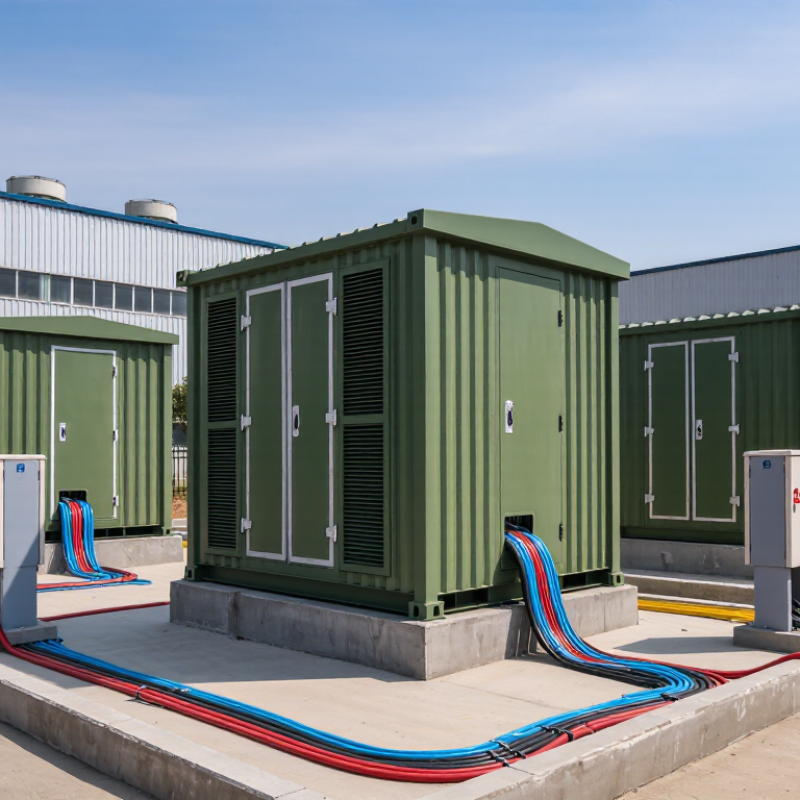
A radial-feed padmount transformer receives power through one primary circuit and supplies a lower-voltage network. Its grounded tank sits on a concrete pad, often beside a commercial building or residential development. Inside, the primary and secondary windings transfer energy through a magnetic core. High-voltage bushings, protective fuses, and a low-voltage compartment support connection and maintenance. Unlike a loop-feed arrangement, a basic radial design has no alternate incoming path. If its supply cable fails, downstream customers may lose power until crews isolate and repair the fault.
The U.S. Department of Energy’s 2016 distribution-transformer analysis estimated roughly 60 million units in service nationwide and about 61 terawatt-hours of annual transformer losses. Those figures cover the broader transformer fleet, not radial padmount units alone. Still, they show why efficiency and correct sizing matter. Engineers check load profiles, ambient temperature, voltage, impedance, and available fault current before specifying a unit. IEEE C57.12.34 provides requirements for certain three-phase pad-mounted distribution transformers. A compact cabinet can look simple from outside. The protection details are not. Radial systems can be economical and straightforward, but their limited supply path deserves honest attention during outage planning.
China Top Radial Feed Padmount Transformer Suppliers? – What Is a Radial Feed Padmount Transformer?
| Topic | Typical Information | What Buyers Should Verify |
|---|---|---|
| Definition | A radial-feed padmount transformer receives power through one primary incoming circuit and supplies a lower-voltage distribution circuit. | Confirm the one-source arrangement suits the network’s reliability and switching requirements. |
| Radial feed vs. loop feed | A radial unit generally has one primary source. A loop-feed design provides two primary cable ways, allowing the primary circuit to continue through the installation. | Check the one-line diagram, number of primary bushings, and switching arrangement; terminology and configurations can vary by utility. |
| Common applications | Commercial buildings, industrial sites, renewable-energy facilities, and other outdoor distribution installations. | Match the enclosure, access, clearances, and protection scheme to the site and local electrical requirements. |
| Rated capacity | Capacity is specified in kVA or MVA. The appropriate rating depends on the connected load, demand profile, and planned expansion; there is no single rating for all installations. | Request the nameplate rating, temperature-rise rating, cooling method, and applicable overload guidance. |
| Voltage and frequency | Primary and secondary voltage ratings, phase, frequency, and connection must be selected for the project’s electrical system. | Confirm system voltage, insulation level, tap range, vector group, and frequency on the approved datasheet. |
| Insulating and cooling medium | Liquid-immersed distribution transformers may use mineral oil or specified alternative insulating liquids; dry-type designs are a separate equipment category. | Check the specified liquid, environmental and fire-safety requirements, and local rules for containment and installation. |
| Primary protection and switching | Depending on the design, equipment may include a load-break switch, fuses, or other specified protective devices. | Verify device ratings, coordination with upstream protection, cable interfaces, and utility-approved operating procedures. |
| Applicable standards | Relevant requirements may include IEC 60076 for power transformers, IEEE C57.12.34 for certain pad-mounted distribution transformers, and applicable Chinese GB standards. | Identify the exact standard edition and scope in the purchase specification; confirm acceptance with the destination utility and authority having jurisdiction. |
| Factory testing and documentation | Transformer test documentation commonly covers routine electrical tests and nameplate data; additional tests may be specified by the purchaser or standard. | Request a test schedule, certified reports, drawings, manuals, and traceable serial-number documentation before shipment. |
| Supplier evaluation in China | Compare manufacturers using verified technical compliance, production capability, quality controls, test facilities, export experience, and service arrangements. | Assess each supplier against the same specification and verify certificates, factory audit evidence, references, warranty terms, and spare-parts support independently. |
| Delivery and installation | Transport dimensions, lifting points, shipping protection, site access, and foundation details are project-specific. | Agree on the approved outline drawing, delivery terms, inspection points, installation clearances, and commissioning responsibilities. |
Specifications vary by manufacturer, utility, and project. Confirm all ratings and compliance requirements against the approved project specification before ordering.
FAQS
It receives power through one primary circuit and supplies a lower-voltage network. Its grounded tank usually sits on a concrete pad.
Customers downstream may lose power until crews isolate and repair the fault. There is no alternate incoming path.
Many units serve 50 Hz networks, often stepping 10 kV down to 0.4 kV. Actual values depend on the utility connection and load study.
They can serve commercial buildings, residential developments, and industrial parks. Check site access before choosing a location.
Review capacity, impedance, winding configuration, insulation level, and guaranteed no-load and load losses. Also check temperature rise and short-circuit withstand.
Request routine test records, a dimensioned drawing, and verified loss data. Ask whether testing is performed in-house.
Confirm cable access, elbow clearance, ventilation space, noise limits, and enclosure corrosion protection. Small details matter.
No. Feeder conditions, load profile, ambient temperature, and fault current can change what is suitable. A datasheet may not show the whole picture.
Transformer losses add up during years of operation. A broader national estimate covered about 60 million transformers, not radial padmount units alone.
Conclusion
A Radial-feed padmount transformer is a ground-mounted distribution unit designed to receive power through a single incoming circuit and supply electricity to local loads. Its enclosed construction supports outdoor installation, while the radial arrangement can simplify network planning and equipment coordination. In China, these transformers may serve commercial buildings, residential developments, industrial facilities, and infrastructure projects. Key selection factors include rated capacity, primary and secondary voltage, insulation and cooling methods, enclosure protection, safety features, and compatibility with the intended network.
Chinese suppliers vary in their manufacturing scale, engineering services, testing resources, and ability to customize equipment. When evaluating a supplier, buyers should compare technical documentation, production and quality-control processes, relevant certifications, delivery capability, warranty terms, and after-sales support. Clear project requirements and careful review of specifications can help identify a suitable solution for a particular distribution application.