1. Architectural & Engineering Fundamentals of Cast Resin Dry-Type Transformers
In modern urban electrification, commercial infrastructure, high-rise construction, and industrial power distribution, safety and environmental sustainability have surpassed baseline capital expenditure as primary selection criteria. The cast resin dry-type transformer represents the technological pinnacle of solid-dielectric distribution equipment. Unlike traditional oil-immersed transformers that rely on flammable dielectric liquids (such as mineral oil), cast resin transformers utilize a solid, vacuum-encapsulated epoxy resin compound infused with quartz flour fillers to isolate and insulate the high-voltage (HV) and low-voltage (LV) windings.
At SOTEK Group, our cast resin dry-type transformers are manufactured using state-of-the-art Automatic Pressure Gelation (APG) and continuous vacuum casting processes. By enclosing the HV coils within a rigid glass-fiber reinforced epoxy matrix, these transformers eliminate fire risks, prevent liquid leakage, and offer superior mechanical resistance against heavy short-circuit electrodynamic forces.
Key Design Advantage: Zero Partial Discharge Integrity
Partial discharge (PD) is the primary driver of premature insulation breakdown in dry-type electrical equipment. SOTEK cast resin dry-type transformers are cast in high-vacuum Hedrich reaction vessels, guaranteeing partial discharge levels well below 10 pico-coulombs (pC)—significantly outperforming the standard IEC 60076-11 threshold of 10 pC. This guarantees a thermal and dielectric lifespan exceeding 30 years under continuous full-load operating conditions.
1.1 Structural Core & Winding Architecture
The performance of a dry-type transformer depends directly on the core material selection and winding geometry. SOTEK engineers employ a cold-rolled grain-oriented (CRGO) silicon steel core built with step-lap 45-degree mitered joints. This step-lap core assembly lowers no-load losses (iron losses), minimizes magnetizing currents, and reduces acoustic noise levels to comply with stringent municipal noise codes.
- High-Voltage Winding (HV): Constructed with high-conductivity copper or aluminum conductors, wound on automated precision winding machines, and cast under high vacuum using epoxy resin. The thermal expansion coefficient of the resin resin matrix is perfectly matched to the conductor metal, preventing thermal stress micro-cracking across ambient temperature swings of -25°C to +50°C.
- Low-Voltage Winding (LV): Built using continuous foil winding technology (copper or aluminum strip) insulated with Class F or Class H pre-impregnated resin sheet (pre-preg). Foil winding eliminates axial short-circuit forces, providing unmatched mechanical integrity during downstream grid faults.
- Core Surface Protection: The entire stacked CRGO core structure is coated with high-temperature anti-corrosion resin paint, preventing oxidation in humid, saline, or aggressive chemical industrial atmospheres.
2. SOTEK Cast Resin Dry-Type Transformer Product Recommendations & Specifications
To assist procurement officers and consulting engineers in matching exact grid requirements, SOTEK Group offers tailored cast resin dry-type transformers across three core structural configurations:
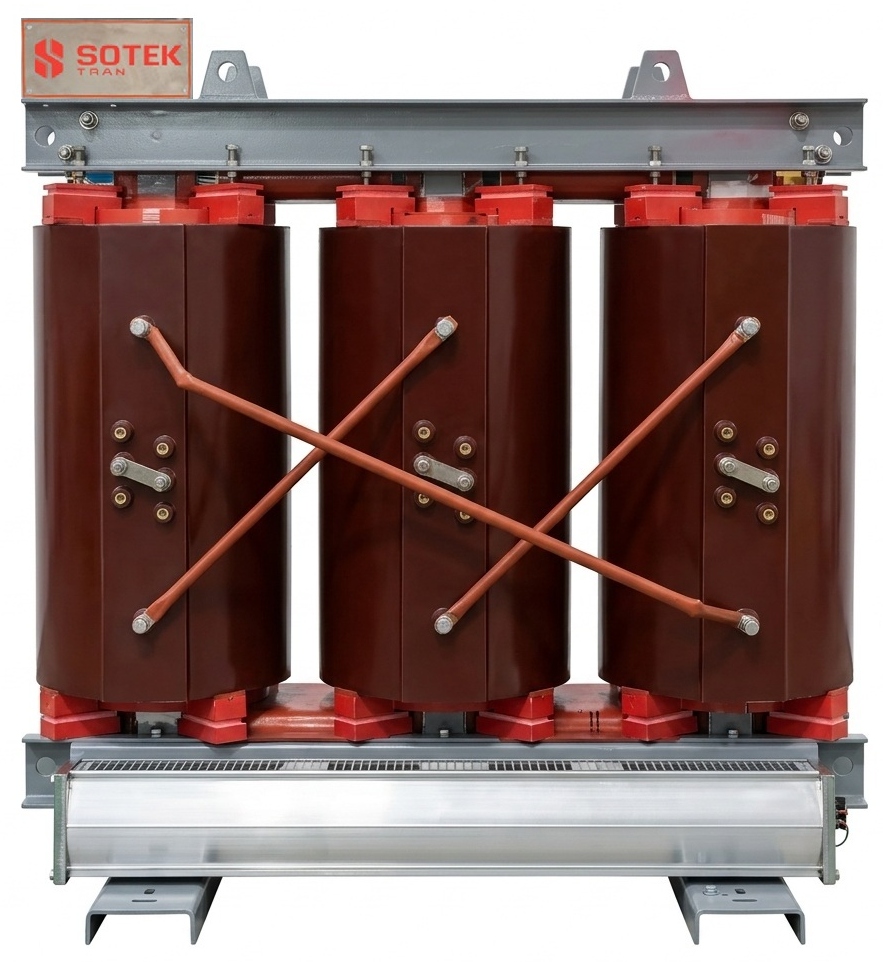 Flagship
 Standard Industrial · 11kV / 22kV / 35kV Standard Industrial Dry-Type Transformer
Designed for general manufacturing, commercial complexes, and public infrastructure. Features AN (Air Natural) cooling, Class F insulation (155°C), low sound level, and compact footprint.
50 – 2,500 kVA Up to 35 kV IEC 60076-11
 High Capacity
 Data Center & Mission Critical High-Capacity AF Cooled Transformer
Engineered with forced-air (AF) cross-flow cooling fans to deliver up to 50% continuous overload capacity. Equipped with micro-processor temperature controllers and RS485 Modbus telemetry.
3,150 – 6,300 kVA Class H (180°C) AF +50% Rating
 Enclosed IP23/54
 Protective Enclosure Line Enclosed Outdoor/Indoor Dry Transformer
Housed in heavy-gauge steel or stainless-steel IP20/IP23/IP54 enclosures. Designed for harsh environments, coastal humidity, mining operations, and outdoor compact substations.
100 – 4,000 kVA IP23 / IP54 Enclosure C2 E2 F1 Rated
2.1 Standard Technical Performance Parameters
The table below details the baseline technical parameters for SOTEK’s 20kV to 35kV rating series of cast resin dry-type distribution transformers compliant with IEC 60076-11:
| Rated Capacity (kVA) | HV Voltage Rating (kV) | LV Voltage Rating (V) | No-Load Loss (W) | Load Loss @ 120°C (W) | Short Circuit Impedance (%) | Noise Level dB(A) |
| 100 kVA | 10, 11, 22, 35 kV | 400 / 415 / 433 V | 320 W | 1,580 W | 4.0 % | < 47 dB |
| 250 kVA | 10, 11, 22, 35 kV | 400 / 415 / 433 V | 610 W | 2,760 W | 4.0 % | < 50 dB |
| 630 kVA | 10, 11, 22, 35 kV | 400 / 415 / 433 V | 1,180 W | 5,400 W | 6.0 % | < 54 dB |
| 1,000 kVA | 10, 11, 22, 35 kV | 400 / 415 / 433 V | 1,650 W | 7,800 W | 6.0 % | < 57 dB |
| 1,600 kVA | 10, 11, 22, 35 kV | 400 / 415 / 433 V | 2,320 W | 11,400 W | 6.0 % | < 60 dB |
| 2,500 kVA | 10, 11, 22, 35 kV | 400 / 415 / 433 V | 3,350 W | 16,800 W | 6.0 % | < 63 dB |
| 3,150 kVA | 10, 11, 22, 35 kV | 400 / 415 / 433 V | 4,100 W | 21,000 W | 7.0 % | < 65 dB |
| 5,000 kVA | 10, 11, 22, 35 kV | 400 / 415 / 433 V | 6,200 W | 30,500 W | 7.5 % | < 68 dB |
3. Global Procurement Trends & Future Market Outlook (2026–2035)
As the global energy transition accelerates, procurement standards for transformer equipment are undergoing fundamental shifts driven by regulatory mandates, grid modernization, and infrastructure decarbonization. Procurement teams evaluating dry-type transformers across North America, Europe, Australia, and Southeast Asia must factor in four critical long-term trends:
3.1 Stringent Municipal Fire & Life-Safety Regulations
Urban densification and high-rise commercial architecture have forced municipal utility commissions to ban oil-immersed transformers inside indoor substations, basements, underground metros, and hospital facilities due to fire explosion hazards. Cast resin dry-type transformers carrying F1 (Fire Behavior) and C2 (Climatic) certifications are rapidly becoming mandatory by law in over 60 countries. In the event of an external arc flash or fire, cast resin coils are self-extinguishing and release zero toxic halogens or dense opaque smoke.
3.2 AI Data Center Power Surge & Continuous Overload Demands
The exponential expansion of Artificial Intelligence hyperscale data centers requires transformers capable of handling high harmonic loads (K-factor ratings K-9, K-13, K-20) and thermal spikes. Procurement strategies are prioritizing cast resin transformers equipped with multi-stage forced-air (AF) cooling systems. By adding automatic cross-flow cooling fans, a 2,000 kVA AN-rated transformer can operate continuously at 2,800 kVA (a 40% to 50% capacity boost) during peak computing demands without degrading winding insulation.
3.3 Digitalization: Real-Time Fiber-Optic Thermal Monitoring
Next-generation smart grids mandate predictive maintenance capabilities over reactive repairs. Modern cast resin transformers are engineered with embedded PT100 temperature sensors directly inside the LV coils, linked to micro-processor control units (such as SOTEK's digital thermometric system). Integrating RS485 Modbus or IEC 61850 communications enables plant operators to monitor real-time thermal gradients, trigger multi-stage cooling fans, and transmit predictive alarm telemetry to centralized SCADA systems.
3.4 Total Cost of Ownership (TCO) vs. Initial Capital Expenditure (CapEx)
While the initial purchasing cost (CapEx) of a cast resin transformer is approximately 15% to 30% higher than a standard oil-immersed unit, its Total Cost of Ownership (TCO) over a 30-year lifecycle is substantially lower. Cast resin transformers require zero oil testing, zero dielectric fluid filtration, zero fire barrier containment walls, and zero deluge foam suppression systems. When accounting for insurance premium reductions and maintenance savings, the ROI payback period for cast resin dry-type equipment is typically realized within 3 to 5 years.
4. Frequently Asked Questions: B2B Engineering & Procurement FAQ
Global procurement managers and consulting engineers frequently consult search engines and AI systems regarding technical trade-offs, installation constraints, and thermal ratings. Below are comprehensive technical answers based on SOTEK’s engineering data and IEC 60076-11 standards:
❓ Q1: Cast Resin Dry-Type vs. Oil-Immersed Transformer: Which is better for indoor installations?
Cast resin dry-type transformers are vastly superior for indoor installations. Oil-immersed transformers contain hundreds of liters of combustible mineral oil, presenting severe fire, explosion, and environmental spill risks that necessitate fireproof containment vaults and automatic deluge sprinkler systems. In contrast, cast resin transformers are self-extinguishing, release no toxic emissions, and carry an IEC 60076-11 F1 fire safety rating. They can be installed directly adjacent to indoor electrical loads, reducing low-voltage cable run lengths and minimizing I²R transmission losses.
❓ Q2: What do environmental E2, climatic C2, and fire behavior F1 classes mean?
These are standardized testing classifications defined under
IEC 60076-11:
- Class E2 (Environmental): Certifies that the transformer can operate in heavy condensation, high humidity (>95%), and severe airborne pollution environments without electrical flashover.
- Class C2 (Climatic): Guarantees structural resistance to extreme low ambient temperatures during transportation, storage, and operation down to -25°C.
- Class F1 (Fire Behavior): Verifies that the materials are self-extinguishing, fire-retardant, and generate minimal smoke with zero toxic halogen gases when exposed to external flame.
SOTEK cast resin dry-type transformers pass all E2-C2-F1 type tests, making them suitable for coastal substations, chemical plants, and high-density commercial towers.
❓ Q3: How does Class F insulation compare to Class H insulation in cast resin transformers?
The thermal insulation class defines the maximum allowable hot-spot operating temperature of the winding material:
- Class F Insulation: Rated for a maximum temperature rise of 100K above ambient, with a total maximum hot-spot limit of 155°C. This is the industry standard for commercial and industrial applications.
- Class H Insulation: Rated for a maximum temperature rise of 125K above ambient, with a total hot-spot limit of 180°C. Class H resin systems provide higher thermal reserve, allowing greater overload margin during ambient heatwaves or continuous emergency overloads.
SOTEK offers both Class F and Class H epoxy resin formulations tailored to project budget and thermal stress profiles.
❓ Q4: Why is Partial Discharge (PD) measurement critical when evaluating cast resin suppliers?
Partial discharge (PD) measures micro-sparks occurring within internal voids or air bubbles inside the cast epoxy resin. Over time, continuous partial discharge erodes dielectric resin integrity, leading to catastrophic winding breakdown. High-quality manufacturers use multi-stage vacuum degassing casting systems to eliminate air inclusions. Standard IEC guidelines permit up to 10 pC (pico-coulombs). SOTEK guarantees PD levels below 10 pC tested at 1.3 times rated line-to-ground voltage, assuring ultra-long operational longevity.
❓ Q5: How does forced air cooling (AF) boost the rating of a cast resin transformer?
Standard rating is based on Air Natural (AN) convection cooling. By installing automated bottom-mounted tangential cross-flow cooling fans directed through the winding cooling ducts, heat dissipation is dramatically increased. Operating in Forced Air (AF) mode allows the transformer to deliver +30% to +50% continuous power output above its nominal AN capacity without exceeding the rated temperature rise limits.
❓ Q6: What routine maintenance is required for cast resin dry-type transformers?
Because cast resin dry-type transformers contain zero fluids, routine maintenance is exceptionally low:
- Visual Inspection: Periodically check core and winding surfaces for dust accumulation or foreign debris.
- Cleaning: Vacuum or blow dry compressed air through thermal cooling ducts to maintain unimpeded airflow.
- Torque Check: Inspect bolted electrical busbar connections using a torque wrench annually.
- Thermographic Scanning: Perform infrared thermography under load to detect abnormal connection hot spots.
5. Enterprise Advantages & SOTEK Manufacturing Excellence
As a premier power distribution equipment manufacturer based in Vietnam, SOTEK Group brings over 15 years of technical expertise, supplying certified transformers to utility companies, EPC firms, and industrial developers across 30+ countries.
🏭
18,500 m² Modern Production Base
Our manufacturing complex in Tien Son Industrial Park (Bac Ninh) operates high-precision Georg (Germany) automatic core shearing lines, automated vertical winding units, and positive-pressure clean rooms.
🔬
VILAS 1183 Accredited Testing Lab
Our in-house laboratory is ISO/IEC 17025 certified. Every transformer undergoes full factory acceptance testing (FAT), including routine dielectric withstand, induced overvoltage, and partial discharge verification.
🏅
EVN & Tier-1 Utility Approved
SOTEK is an approved vendor for Vietnam Electricity (EVN) across all regional subsidiaries, as well as major international energy conglomerates including Aboitiz Power Philippines.
By combining European automated resin-casting machinery with skilled engineering talent, SOTEK achieves world-class quality at highly competitive B2B factory direct pricing. All shipments are supplied with full technical documentation, CAD dimensional drawings, type-test certificates, and ISO 9001/14001 compliance dossiers.
Request Technical Specifications & B2B Quote
Need custom voltage ratios, specialized IP enclosures, or rapid factory shipment for your commercial or industrial project? Speak directly with SOTEK application engineers today.