Distribution Transformer Technical Articles, Industry Insights & Grid Updates — SOTEK Group
OEM/ODM Custom Instrument & Power Transformers
Explore our state-of-the-art range of oil-immersed, cast resin dry-type, and high-frequency isolation transformers manufactured under rigorous ISO 9001:2015 and ISO/IEC 17025 accredited quality controls.
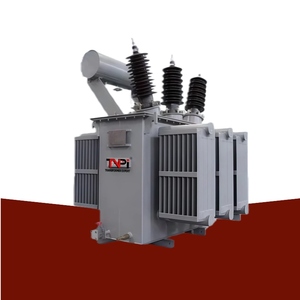
69kV 33kV ONAN Copper Oil Immersed Substation Step Down Transformer
Engineered for high-voltage transmission substations up to 30MVA. Features laser-cut CRGO steel cores and high-dielectric mineral oil insulation.
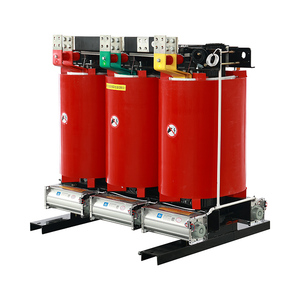
3-Phase 100kVA High Voltage Dry Type Industrial Isolation Transformer
Designed for sensitive industrial automation and precision instrumentation protection. Low thermal stress with superior harmonic suppression.
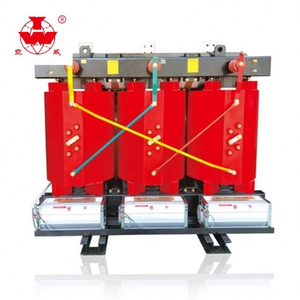
10/11kV 500kVA–2500kVA Cast Resin Dry Type Transformer with Forced Air Cooling
Vacuum cast epoxy resin dry-type unit equipped with auto-thermostatic cooling fans. Flame-retardant, self-extinguishing indoor power center.
CE Certified 35kV to 380V/400V Low-Frequency Three Phase Dry SMPS Transformer
Custom engineered for switched-mode power supplies, heavy industrial drives, and specialized power electronics with extended thermal rating factors.
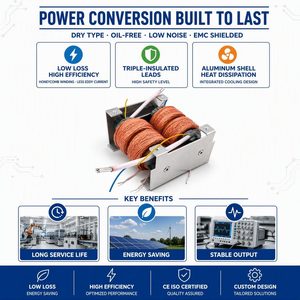
Single Phase 6kV to 220V High Frequency Honeycomb Isolation Custom Transformer
Specialized honeycomb winding geometry minimizes inter-winding capacitance. Ideal for high-precision laboratory and medical instrumentation sensing.
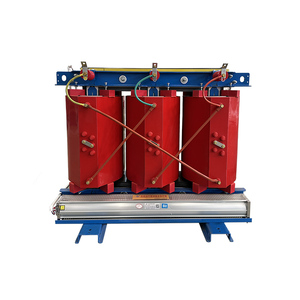
Three Phase 10KV 35KV Dry Type Epoxy Resin Transformer (50Hz/60Hz)
Hermetically encapsulated in solid epoxy resin under deep vacuum. Resists humidity, dust, and aggressive industrial environments with zero oil leakage risk.
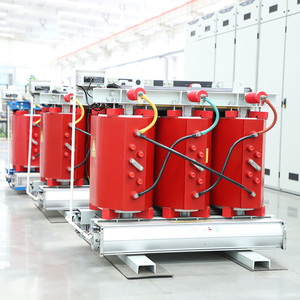
630KVA High Voltage 20kV to 415V Low Loss Dry Type Power Transformer
Designed for optimal energy efficiency and reduced no-load losses. Fully compliant with modern EU EcoDesign and IEEE energy standards.
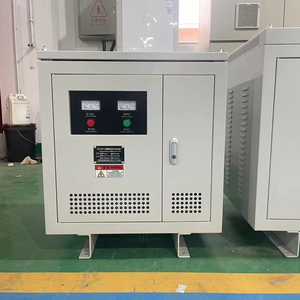
Three Phase SG IEC60076 Isolation Transformer (440V Input / 220V Output)
Robust industrial voltage matching transformer with galvanic isolation shield. Built for international machinery integration and OEM export projects.
OEM/ODM Manufacturing Infrastructure & Technical Superiority
As an ISO 9001:2015 and ISO 14001:2015 certified global power equipment manufacturer, our enterprise operates an 18,500 m² modern manufacturing complex delivering customized instrument and power transformers to utility grids across 30+ countries.
Automated Georg Core Cutting Lines
Equipped with German Georg step-lap automated longitudinal shearing lines for precision cutting of Cold-Rolled Grain-Oriented (CRGO) silicon steel cores, minimizing magnetic flux leakage and no-load excitation currents.
Hedrich Vacuum Casting Chambers
Our dry-type instrument transformer line utilizes advanced Hedrich deep vacuum resin casting technology, guaranteeing micro-bubble-free solid epoxy insulation with partial discharge levels strictly under 5 pico-coulombs (pC).
ISO/IEC 17025 Accredited Test Lab
Our in-house VILAS 1183 testing laboratory performs comprehensive Factory Acceptance Testing (FAT), including 1.2/50µs lightning impulse withstand, induced AC overvoltage, short-circuit withstand, and temperature rise verification.
Technical Evolution & Future Procurement Trends in Instrument Transformers
The global instrument transformer market is undergoing a paradigm shift driven by digital substation modernization, renewable energy grid integration, and stringent decarbonization mandates. B2B procurement managers and EPC engineers must align technical specifications with four critical macro trends:
1. Migration to Non-Conventional Instrument Transformers (NCIT/LPIT)
Traditional electromagnetic CTs and PTs are increasingly replaced by Low-Power Standalone Sensors (LPITs), including Rogowski coils for current sensing and resistive/capacitive voltage dividers. Operating under IEC 61869-6, IEC 61869-10, and IEC 61869-11 standards, LPITs eliminate secondary open-circuit explosive hazards, drastically reduce weight by up to 70%, and provide linear frequency response across wide bandwidths required for renewable inverter monitoring.
2. Digital Substation Integration & IEC 61850 Process Bus
Modern utility procurement requires instrument transformers capable of interfacing directly with Merging Units (MUs). Process bus digitizers sample analog signals at the primary sensor head and output standardized IEC 61850-9-2 LE (Sampled Values) streams over fiber-optic networks. This eliminates hundreds of kilograms of heavy copper secondary control cabling, mitigates electromagnetic interference (EMI), and enables real-time digital twin analytics.
3. Eco-Friendly & Biodegradable Dielectric Insulants
Environmental regulations are accelerating the phase-out of conventional mineral oils and SF6 gas insulants in medium/high-voltage instrument transformers. OEM buyers are mandating synthetic and natural ester fluids (such as FR3) with fire points exceeding 300°C and 100% biodegradability. Simultaneously, cast resin dry-type technology is expanding into 35kV and 69kV outdoor metering applications.
Technology Comparison: Legacy vs. Next-Generation Instrument Transformers
| Evaluation Parameter | Conventional Electromagnetic (CT/PT) | Cast Resin Dry-Type Instrument Units | Optical / LPIT Digital Sensors (NCIT) |
|---|---|---|---|
| Governing Standard | IEC 61869-2 / IEEE C57.13 | IEC 61869-2/3 / IEC 60076-11 | IEC 61869-6 / 10 / 11 / 13 |
| Accuracy Class Range | 0.2S, 0.5, 5P20, TPY | 0.2S, 0.5, 3P, 5P10 | 0.1, 0.2S, 0.5S (Wide Bandwidth) |
| Open-Circuit Hazard | High Risk (Severe Overvoltage) | High Risk (Secondary CT Protection Needed) | Zero Risk (mV or Digital Fiber Output) |
| Harmonic Bandwidth | Limited (50Hz / 60Hz nominal) | Moderate (Up to 25th Harmonic) | Ultra-Wide (Up to 100th Harmonic / DC) |
| Environmental Footprint | Mineral Oil / Maintenance Heavy | Zero Oil Leakage / Eco-Friendly | Compact, 70% Weight Reduction |
Precision Core Engineering & Magnetization Physics
The measurement accuracy and transient response of an instrument transformer depend fundamentally on magnetic core material selection and winding geometry balance. Our ODM factory custom-engineers magnetic circuits according to exact burden and accuracy specifications.
Nanocrystalline Core Alloys for Class 0.2S Revenue Metering
For revenue-grade metering CTs operating under light load conditions (1% to 120% of rated current), traditional silicon steel exhibits non-linear permeability at low flux densities. Our OEM factory integrates ultra-thin (18–25 µm) ribbon-wound nanocrystalline cores ($Fe-Cu-Nb-Si-B$). Nanocrystalline alloys deliver initial permeability values exceeding 80,000—four times higher than permalloy—ensuring negligible phase displacement and flat error curves across extended current ranges.
Ferroresonance Suppression in Potential Transformers (PTs)
Ungrounded or spot-grounded medium-voltage networks are vulnerable to non-linear ferroresonant oscillations between line capacitance and transformer core inductances. Our factory incorporates custom open-delta tertiary damping windings equipped with non-linear ceramic damping resistors (or active electronic damping modules) to dissipate sub-harmonic energy within milliseconds, protecting the PT core from catastrophic thermal breakdown.
Transient Protection Cores (TPY & TPZ Specifications)
In high-voltage transmission lines, short-circuit fault currents contain decaying DC offset components that cause conventional protection cores to saturate rapidly. We manufacture specialized TPY and TPZ class cores with engineered anti-remanence air gaps. These precision air gaps control the remanent flux ratio ($K_r < 10\%$), preventing protective relay blind spots during rapid reclosure duty cycles ($O - 0.3s - CO$).
OEM Supplier Quality Verification & Audit Roadmap
To ensure long-term grid operational resilience and minimize total cost of ownership (TCO), B2B buyers and EPC procurement auditors should evaluate potential instrument transformer manufacturers against four foundational quality verification pillars:
Pillar 1: Raw Material Traceability
Audit supplier material mill certificates for electrolytic copper wire purity (>99.95%), transformer oil breakdown voltage (>60kV), and high-grade CRGO steel (e.g., Baosteel or Nippon Steel). Validate batch-level heat treatment logs.
Pillar 2: Partial Discharge Control
Insist on 100% routine partial discharge testing for all cast resin and dry-type units at 1.2 Un and 1.73 Un voltages. Confirm background lab noise levels remain below 2 pC to guarantee test integrity.
Pillar 3: Type Test Dossier Completeness
Verify third-party type test certifications issued by independent laboratories (such as KEMA, CESI, or ASTA) covering short-circuit thermal dynamic withstand ($I_{th}$ & $I_{dyn}$) and lightning impulse insulation levels.
Frequently Asked Questions (FAQ) for Procurement Engineers
Detailed answers to essential technical, quality, and logistics queries encountered during B2B supplier selection and custom contract negotiation.
Partner with a World-Class Instrument Transformer Manufacturer
Whether you require custom OEM prototype development, specialized accuracy class CT/PT designs, or high-volume power transformer manufacturing, our engineering team is ready to support your grid projects.
Inquire Now