Executive Overview: Navigating High-Voltage Distribution Infrastructure
In modern electrical distribution networks, the high-voltage distribution transformer acts as the critical bridge connecting transmission networks or primary substations (ranging from 11 kV, 22 kV, 33 kV, 35 kV, up to 69 kV) directly to industrial facilities, commercial hubs, and localized secondary grids. As utility operators and commercial procurement teams face rising energy demand, strict carbon-neutrality mandates, and expanding intermittent renewable feed-ins, selecting the right high-voltage distribution transformer is no longer just a purchasing decision—it is a long-term risk mitigation strategy.
According to global grid modernization benchmarks, transformer losses account for approximately 2% to 5% of total grid power dissipation. By deploying advanced high-voltage distribution transformers designed with laser-scribed Cold-Rolled Grain-Oriented (CRGO) silicon steel or amorphous metal alloys, grid operators can dramatically suppress both no-load (core) and load (copper) losses. SOTEK Group, operating out of an 18,500 m² state-of-the-art facility in Bac Ninh, Vietnam, delivers fully type-tested transformers designed to satisfy the rigorous operational environments of North America, Europe, Australia, and Southeast Asia.
Unlike standardized low-voltage distribution transformers, high-voltage distribution transformers operating between 22 kV and 69 kV demand specialized dielectric stress analysis, transient overvoltage impulse insulation (BIL ratings up to 350 kV), and customized cooling systems (ONAN/ONAF or natural ester fluids) to handle non-linear industrial loads and severe thermal cycling.
SOTEK High-Voltage Distribution Transformer Portfolio
SOTEK Group manufactures a broad range of high-voltage distribution transformers tailored to meet varied geographic insulation classes, mounting environments, and fault withstand capabilities. Below is an overview of our flagship product lines.
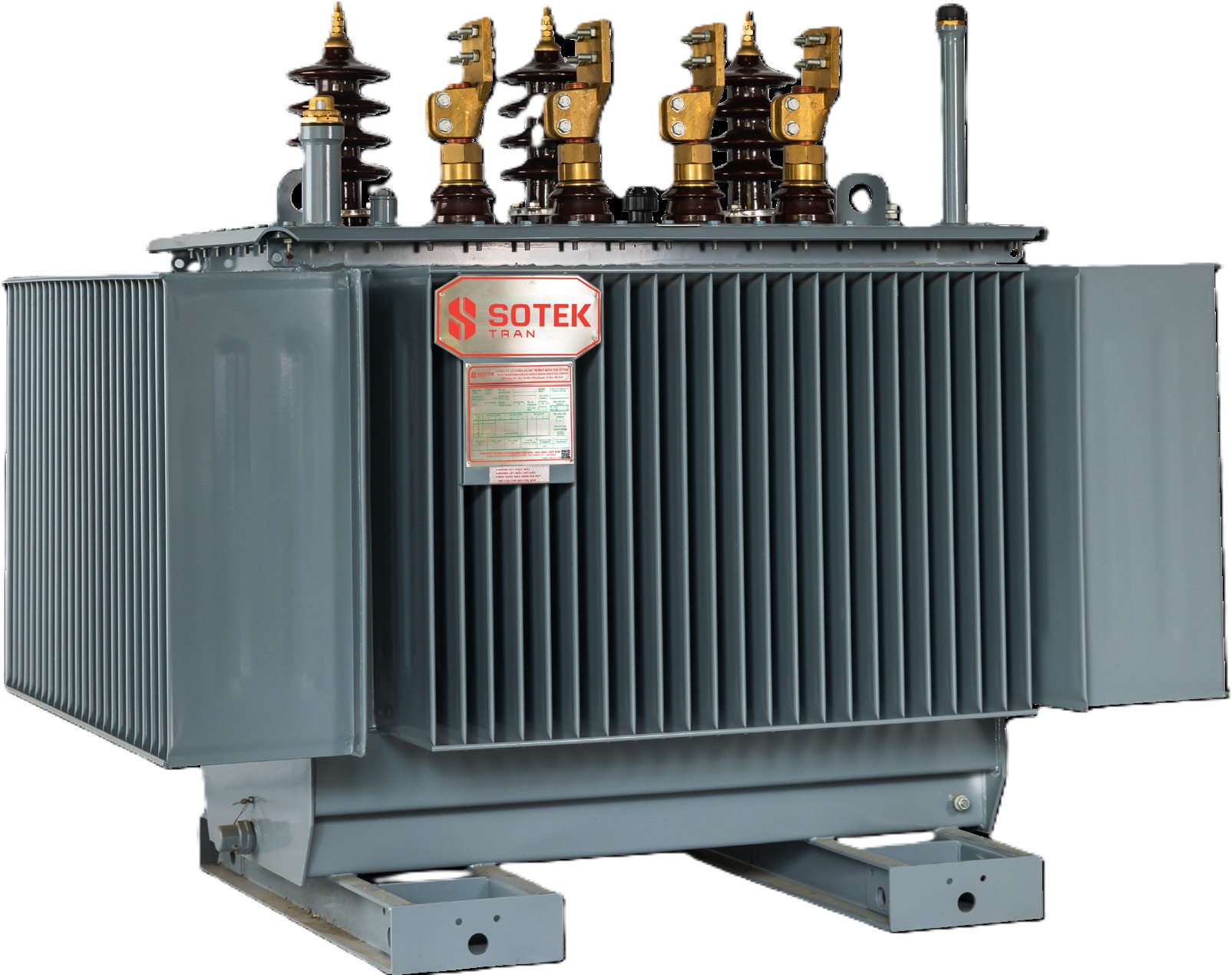 IEC / IEEE Certified
3-Phase Oil-Immersed HV Transformer
Built for utility distribution networks and industrial plant substations. Features hermetically sealed corrugated tanks or conservator designs with high-grade mineral or ester fluids.
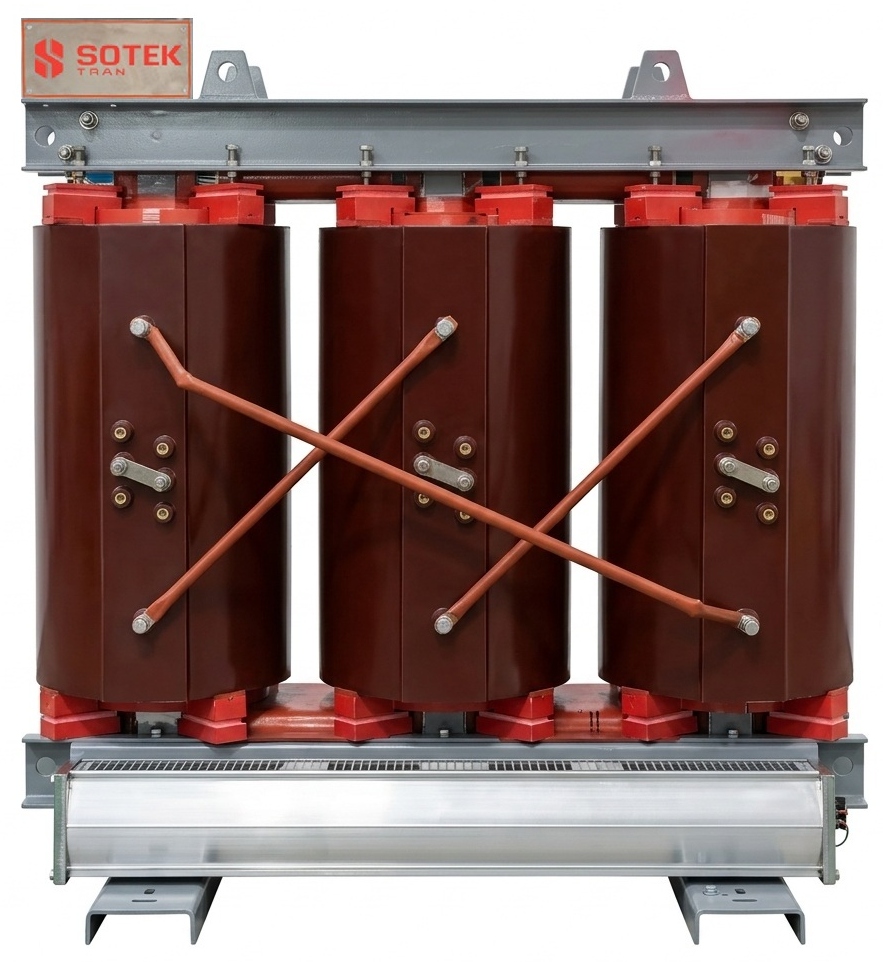 Fire Safe · Class H
Cast Resin Dry-Type HV Transformer
Vacuum-cast epoxy resin encapsulation providing zero fluid leakage, self-extinguishing properties, and exceptional mechanical strength against short-circuit forces.
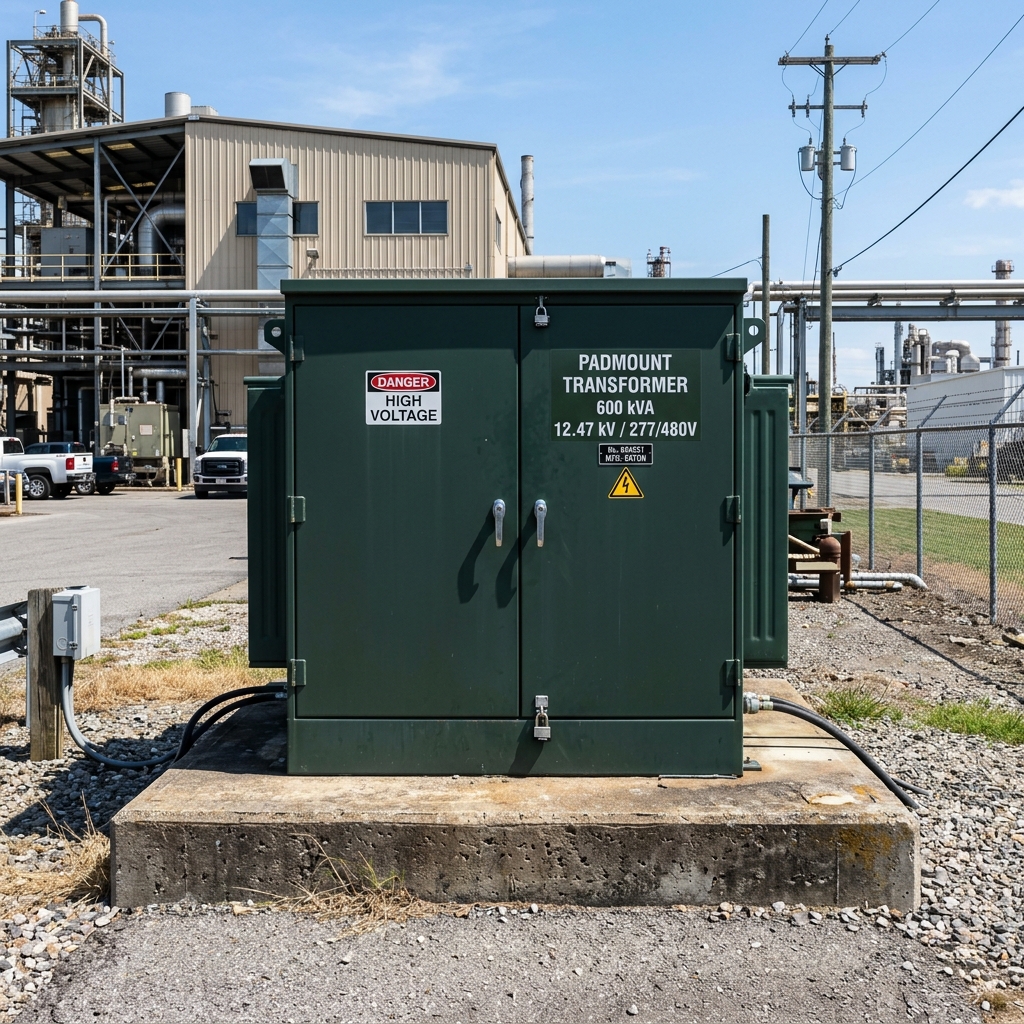 IEEE C57.12.34
HV Padmount Distribution Transformer
Tamper-resistant cabinet enclosure engineered for commercial parks and underground urban networks. Fitted with dead-front elbow connectors and Bay-O-Net fusing.
Comprehensive Technical Specification Comparison
The table below outlines technical benchmarks across SOTEK’s primary high-voltage distribution transformer product lines to assist procurement managers and electrical design leads during project drafting.
| Technical Parameter | Oil-Immersed HV Distribution | Cast Resin Dry-Type HV | Compartmentalized Padmount |
|---|---|---|---|
| Primary Voltage Range | 11 kV, 22 kV, 33 kV, 35 kV, up to 69 kV | 6.6 kV, 11 kV, 22 kV, 35 kV | 11 kV, 13.8 kV, 24.9 kV, 34.5 kV |
| KVA / MVA Range | 50 kVA to 21,000 kVA (21 MVA) | 50 kVA to 6,300 kVA (6.3 MVA) | 75 kVA to 5,000 kVA (5 MVA) |
| Applicable Standards | IEC 60076, IEEE C57.12.00, TCVN 6306 | IEC 60076-11, IEEE C57.12.01, EN 50541-1 | IEEE C57.12.34, ANSI C57.12.28, CSA C227.4 |
| Cooling Medium / Type | Mineral Oil (IEC 60296) or FR3 Natural Ester (ONAN/ONAF) | Natural Air (AN) or Forced Air (AF) with Fans | Mineral Oil or Biodegradable Ester (ONAN) |
| Insulation Thermal Class | Class A (105°C) Top Oil Temp Rise 60K/65K | Class F (155°C) or Class H (180°C) | Class A (105°C) Average Winding Rise 65°C |
| Basic Impulse Level (BIL) | Up to 350 kV BIL (for 69 kV Class) | Up to 170 kV BIL (for 35 kV Class) | Up to 150 kV BIL (for 34.5 kV Class) |
| Core Material Structure | High-Permeability CRGO / Amorphous Metal | Laser-Scribed CRGO Silicon Steel | Step-Lap Mitered CRGO Silicon Steel |
| Enclosure Protection Class | IP54 / IP65 Hermetically Sealed Tank | IP00 (Indoor), IP23, IP31 with Cabinet | NEMA 3R / IP54 Tamper-Proof Dead-Front |
Technology Development Trends in High-Voltage Distribution Transformers
The electrical power industry is undergoing a structural transition driven by grid decarbonization, digitalization, and higher voltage distribution architectures. As high-voltage distribution transformers are deployed closer to load centers to reduce transmission cable line losses ($I^2R$ losses), several vital technological advancements have emerged:
1. Eco-Efficient & Biodegradable Ester Dielectric Fluids
Traditional mineral oil is rapidly being superseded in sensitive installations by Synthetic and Natural Ester fluids (such as Cargill FR3). Natural esters possess a fire flash point exceeding 300°C (K-class fluid rating), virtually eliminating explosion risks in high-density urban substations or renewable farms. Furthermore, natural esters are 100% biodegradable within 28 days, preventing environmental soil contamination in the event of an unexpected tank breach.
2. Amorphous Alloy Core Manufacturing for Ultra-Low Standby Losses
With distribution networks experiencing fluctuating renewable loads (solar PV arrays during night hours or off-peak industrial cycles), core losses (no-load loss) contribute significantly to annual utility financial losses. Amorphous alloy cores—featuring a non-crystalline atomic arrangement created via ultra-rapid cooling—exhibit a magnetic hysteresis loop that reduces no-load core losses by 70% to 80% compared to traditional CRGO steels.
3. Smart Sensor Integration & On-line DGA Monitoring
High-voltage distribution transformers above 33 kV are increasingly retrofitted with Internet of Things (IoT) diagnostic suites. Fiber-optic temperature sensors embedded directly inside high-voltage coil windings provide real-time hot-spot tracking. Simultaneously, online Dissolved Gas Analysis (DGA) sensors measure moisture, hydrogen ($H_2$), and acetylene ($C_2H_2$) levels inside the oil tank, enabling predictive maintenance algorithms to execute before catastrophic dielectric breakdowns occur.
4. High-Frequency Harmonic Suppression for Inverter Integration
The proliferation of utility-scale solar PV inverters and EV ultra-fast charging plazas introduces severe high-frequency harmonics ($K$-factor loads) into high-voltage distribution transformers. Modern designs utilize electrostatic shields between primary and secondary windings, copper foil low-voltage conductors, and specialized core geometry to dissipate harmonic-induced eddy current heat.
Future Procurement Trends for B2B Utilities & Global Buyers
Procurement leaders managing grid expansion projects in North America, Europe, Australia, and ASEAN must adapt to changing supply dynamics. Key procurement trends shaping high-voltage transformer sourcing include:
- Shift to Total Cost of Ownership (TCO) Evaluation: Forward-thinking utilities no longer buy based on initial capital expenditure (CapEx) alone. Modern procurement formulas evaluate transformers using the $TCO = A \cdot P_0 + B \cdot P_k + \text{CapEx}$ equation, where $A$ and $B$ factors represent the monetary penalty per watt of core loss ($P_0$) and copper loss ($P_k$) over a 30-year lifecycle. SOTEK’s low-loss engineering consistently delivers lower TCO values.
- Supply Chain Diversification away from Single-Region Bottlenecks: With Western lead times for high-voltage transformers stretching to 100+ weeks due to regional labor shortages and steel quota constraints, procurement teams are actively establishing direct relationships with tier-1 Asian exporters like Vietnam. SOTEK Group provides reliable 16-to-24-week lead times backed by direct maritime routes from Hai Phong port.
- Mandatory Digital Twin & Remote Factory Acceptance Testing (FAT): Physical travel restrictions and expedited project timelines have popularized high-definition remote FAT protocols. Buyers can inspect core assembly, observe high-voltage dielectric impulse testing live via calibrated laboratory feeds, and verify test report numbers in real time.
- Raw Material Price Indexing & Transparency: Volatility in LME copper, aluminum, and CRGO silicon steel pricing has led to transparent index-linked contracting. SOTEK offers structured B2B supply agreements with clear raw material indexing, insulating buyers against arbitrary price spikes during long manufacturing cycles.
Frequently Asked Questions: High-Voltage Distribution Transformers
Below are authoritative engineering and procurement answers to the most common questions asked by global power engineers and B2B buyers regarding high-voltage distribution transformers.
What is the technical distinction between a High-Voltage Distribution Transformer and a Power Transformer?
The primary difference lies in their operational location, sizing, and load profile handling. High-voltage distribution transformers generally operate at rated primary voltages up to 69 kV with power ratings typically up to 21 MVA (21,000 kVA). They step down voltage directly for distribution feeders or commercial site consumption and operate under fluctuating load factors. Power transformers, conversely, operate at transmission voltages (110 kV, 220 kV, 500 kV) with ratings exceeding 25 MVA, running near 100% continuous full-load capacity to bulk transfer energy across long distances.
How do IEEE C57 and IEC 60076 standards differ for high-voltage distribution transformers?
While both standards ensure safe, reliable transformer performance, key differences exist in loss testing temperature references, winding temperature rise definitions, and structural configuration:
- Reference Temperature: IEC 60076 references load loss calculations at 75°C (for Class A oil transformers), whereas IEEE C57.12.00 references load losses at 85°C.
- Temperature Rise Limits: IEC specifies a standard top oil temperature rise of 60K and average winding rise of 65K. IEEE C57 allows a 65°C average winding rise above a 30°C average ambient, with options for 55°C/65°C dual ratings.
- High-Voltage Terminal Markings: IEC uses alphanumeric labeling ($H_1, H_2, H_3$ or $1U, 1V, 1W$), while IEEE utilizes $H_1, H_2, H_3$ for high voltage and $X_1, X_2, X_3, X_0$ for low voltage.
What Basic Impulse Level (BIL) should be specified for 33 kV and 69 kV distribution grids?
BIL (Basic Impulse Level) defines the transformer’s ability to withstand atmospheric lightning surges and switching transients:
- 33 kV / 35 kV Class: Standard IEC 60076 BIL is typically 170 kV or 200 kV peak lightning impulse withstand. Under IEEE standards for 34.5 kV systems, 150 kV or 200 kV BIL is standard.
- 69 kV Class: Standard BIL selection is 350 kV peak impulse withstand, though heavily shielded substations may specify 250 kV or 300 kV BIL depending on surge arrester protection schemes.
Why should buyers consider Natural Ester (FR3) fluids instead of Mineral Oil for high-voltage units?
Natural ester fluids offer three compelling engineering advantages:
- Fire Safety: Flash point above 300°C and fire point above 340°C (K3 rating), eliminating the need for expensive fire suppression deluges or firewall barriers between transformers.
- Insulation Longevity: Natural ester absorbs water generated by cellulose thermal aging, extending the paper insulation life by up to 5 to 8 times compared to mineral oil.
- Environmental Compliance: Non-toxic and non-hazardous to aquatic biology, fulfilling strict corporate ESG mandates.
How does SOTEK ensure short-circuit withstand capabilities on high-kVA distribution transformers?
Short-circuit electromechanical forces can reach tens of tons during line faults. SOTEK prevents coil deformation through finite element method (FEM) magnetic stress analysis, dynamic axial clamping structures, high-density pressboard spacers, and thermally cured thermo-stick epoxy insulation paper. Every design is validated according to IEC 60076-5 short-circuit testing guidelines.
What factory testing documentation is delivered with international B2B shipments?
Every SOTEK high-voltage distribution transformer undergoes 100% routine factory acceptance testing at our ISO/IEC 17025 accredited laboratory (VILAS 1183). The final documentation dossier includes:
- Routine Test Reports (Winding resistance, voltage ratio, phase displacement, no-load loss/current, load loss/impedance, applied AC voltage, and induced overvoltage withstand).
- Type & Special Test Certificates (Lightning impulse withstand, temperature rise test, sound level measurement, and short-circuit withstand validation from recognized bodies such as KEMA / QUATEST 1).
- As-built CAD dimensional drawings, wiring schematics, and complete installation/operating manuals.
Enterprise Advantages: Why Partner with SOTEK Group Vietnam
Founded in 2008, SOTEK Group (SOTEK Transformer Production and Trading Corporation) has grown into Southeast Asia’s premier high-voltage transformer manufacturer. Headquartered in the Tien Son Industrial Zone, Bac Ninh Province, Vietnam, SOTEK operates an advanced 18,500 square meter manufacturing plant serving national grid entities like EVN (Electricity of Vietnam), regional utility giants such as Aboitiz Power (Philippines), and global EPC contractors across 30+ countries.
World-Class Manufacturing
Equipped with Heinrich Georg (Germany) automatic CNC silicon steel core-cutting lines, automated vertical layer winding machines, and Hedrich (Germany) vacuum drying and casting chambers.
VILAS 1183 Accredited Lab
Our in-house high-voltage testing facility holds ISO/IEC 17025 certification (VILAS 1183), featuring a 800 kV lightning impulse generator and partial discharge measurement suites.
EVN & International Approval
Approved vendor for all five EVN regional power corporations. Type-tested and validated by independent third parties including KEMA, ASTA, and QUATEST 1.
Tailored Engineering R&D
In-house engineering team specializing in customized primary tap ranges (DETC / OLTC), dual-voltage primary windings, low-noise acoustic enclosures, and specialized solar PV inverter step-up designs.
Robust Export Packaging
Export-grade vacuum-sealed barrier foil packaging with rust-inhibiting nitrogen purging, heavy-duty seaworthy wooden skids, and ocean freight logistics to major ports worldwide.
Lifecycle Technical Support
Dedicated field support team providing site commissioning assistance, transformer oil analysis consulting, and spare parts supply throughout the 30-year operational life of the unit.
Ready to Accelerate Your High-Voltage Grid Project?
Download our complete technical catalog or request an instant factory B2B quote for your high-voltage distribution transformer specifications.